
What Is the Difference Between an Australian Labradoodle and a Labradoodle?
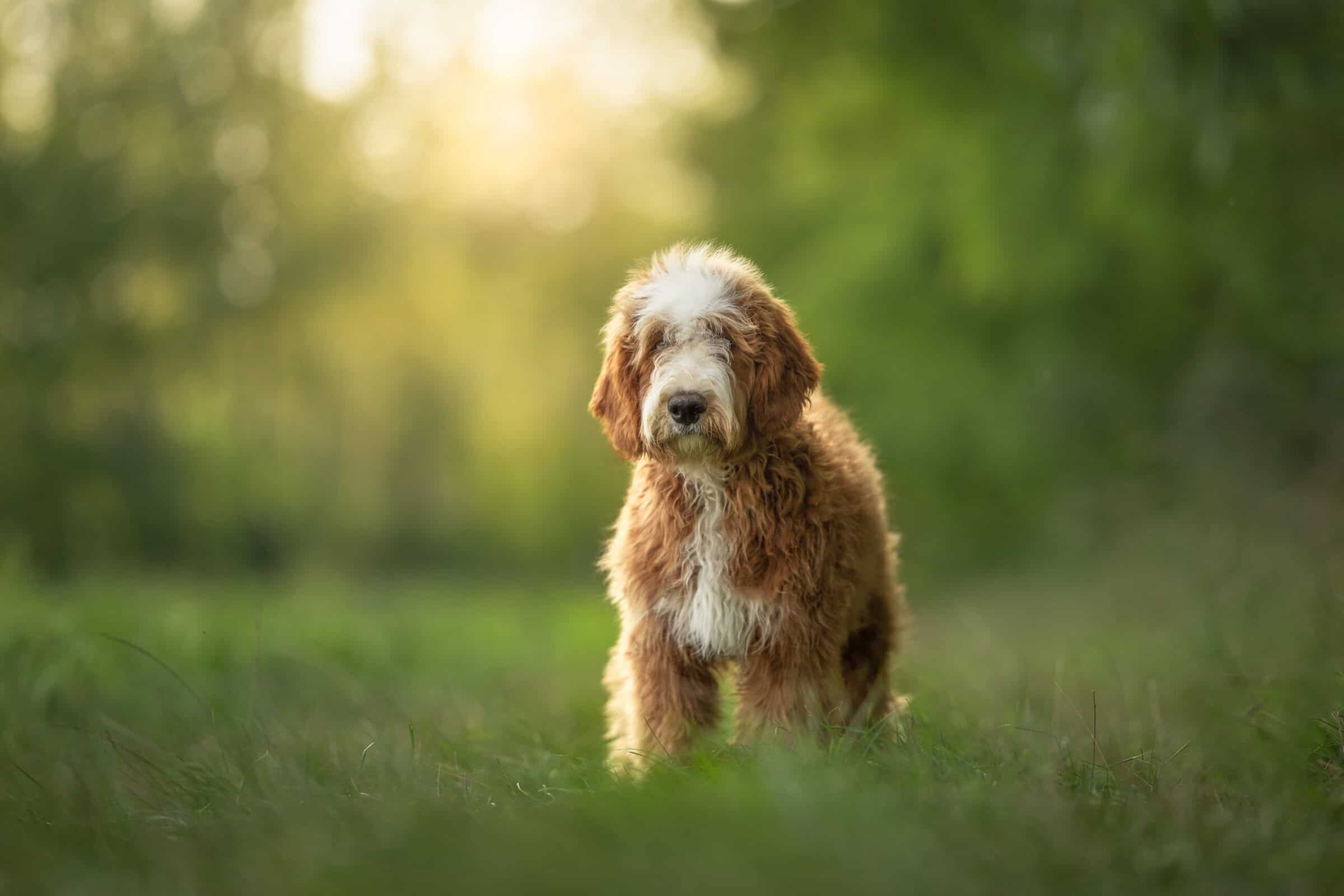
The Labradoodle is one of the most popular dogs in the United States and Northern Europe, loved for its sociable, intelligent nature and its hypoallergenic side. But behind this single name are actually two quite distinct types: the classic Labradoodle and the Australian Labradoodle. Their names sound similar, but their origins, temperament, appearance, and needs can vary considerably. Here’s what actually separates them.
1. Difference in origin and genetic lineage
The classic Labradoodle
The Labradoodle was born in the 1980s, when a Labrador Retriever was crossed with a Poodle. The goal was to create a hypoallergenic, intelligent dog, particularly to meet the needs of people with allergies.
This cross produced a dog with highly variable appearance and character, depending on the proportions of Labrador and Poodle. The term “Labradoodle” therefore refers to a wide range of dogs from this cross, with no official standard recognized by major kennel clubs.
Today in France you can find very varied generations of Labradoodles, from F1 (first generation, cross between a Labrador and a Poodle) to F4-F5. It is still difficult to speak of physical harmony or a Labradoodle standard.
Most Labradoodles in France are not tested for genetic diseases.
The Australian Labradoodle
The Australian Labradoodle, on the other hand, comes from a more complex breeding program, launched in Australia in the 1990s. It’s not simply a cross between a Labrador and a Poodle: Australian breeders introduced other breeds into the line, such as the English Cocker Spaniel, the American Cocker Spaniel, the Wheaten Terrier, and the Irish Water Spaniel.
The goal was to create a homogeneous, stable breed with a gentle temperament and a uniform appearance. The result: a hypoallergenic, sociable, intelligent dog well suited to families as well as animal-assisted therapy.
The Australian Labradoodle is a breed recognized in the United States, meaning it has pedigrees and undergoes strict selection in terms of both morphology and numerous health tests (genetics, hips, elbows, eyes, etc.).
2. Difference in physical appearance between an Australian Labradoodle and a Labradoodle
Sizes
Both types of Labradoodles can come in three sizes:
- Standard (20 to 25 kg)
- Medium (13 to 20 kg)
- Miniature (7 to 13 kg)
However, the Australian Labradoodle is generally more consistent in size, thanks to stricter selection. Among classic Labradoodles, the variation between individuals is often greater.
Coat
This is often where confusion is greatest:
- The classic Labradoodle can have a coat that is curly, wavy, woolly, or even straight. It may be hypoallergenic, but this is not guaranteed.
- The Australian Labradoodle has a more uniform coat, often wavy “fleece” type or curly “wool” type. It is considered hypoallergenic in most cases.
Color
Both breeds can display a wide variety of colors: chocolate, cream, caramel, black, apricot, red, and even multicolor coats such as parti, phantom, or merle (with some breeders).
Here again, the Australian Labradoodle is more consistent, with well-defined coats, often the result of meticulous breeding work.
3. Temperament and behavior differences between an Australian Labradoodle and a Labradoodle
The classic Labradoodle
Like any crossbred dog, its temperament depends a lot on its parents. Some Labradoodles are very sociable, intelligent, and easygoing. Others may inherit a more energetic, stubborn, or nervous temperament, particularly if they come from early generations (F1, F2).
The Australian Labradoodle
Thanks to careful selection over several generations, the Australian Labradoodle is known for its particularly stable temperament:
- Gentle and affectionate
- Very sociable with humans as well as animals
- Easy to train
- Perfect for children, elderly people, or people with disabilities
It is often used as an assistance, therapy, or animal-assisted mediation dog, which speaks volumes about its behavioral reliability.
You’ll find even more information about the Australian Labradoodle via the following link: 10 Reasons to Adopt an Australian Labradoodle Rather Than Another Breed
4. Health and life expectancy
Both types of Labradoodles are generally sturdy, with a life expectancy of 12 to 15 years.
However, certain hereditary diseases can occur:
- Hip dysplasia
- Eye diseases (progressive retinal atrophy)
- Genetic disease
The advantage of the Australian Labradoodle is that breeders affiliated with associations such as the WALA (Worldwide Australian Labradoodle Association) or the ALAA (Australian Labradoodle Association of America) commit to carrying out rigorous health tests on their breeding dogs. This considerably limits the risk of hereditary diseases. It is still rare to find a Labradoodle in France that has been tested for various diseases.
5. Grooming and specific needs are fairly similar between an Australian Labradoodle and a Labradoodle
Grooming
Whatever the type of Labradoodle, coat maintenance is essential:
- Regular brushing (2 to 3 times a week)
- Visits to the groomer every 2 to 3 months
- Ear monitoring (prone to infections)
- Regular nail trims
You’ll find plenty of information on Labradoodle grooming via the following link: https://transgroom.com/fr/advice/kitty-talks-dogs-toilettage-de-stan-le-labradoodle.html?msclkid=b6074b1e5eff119e2330231e8ca1ddfc&utm_source=bing&utm_medium=cpc&utm_campaign=GA_NB_All_Categories_DSA_REG%3AFR_LANG%3AFR&utm_term=transgroom.com%2Ffr&utm_content=All%20webpages%20-%20REG%3AFR_LANG%3AFR
Physical activity
Both the Labradoodle and the Australian Labradoodle need about 1 hour of physical activity per day:
- Walks
- Interactive games
- Obedience or clicker training
They love learning, which makes their training fun and effective.
6. Purchase cost and availability
Labradoodle
The price can vary greatly depending on the breeder, the generation (F1, F1B, F2, etc.), and health testing:
- On average: between €1,500 and €3,000
Australian Labradoodle
The price is generally higher, since selection is more thorough and breeders often need to import foreign lines:
- On average: between €3,000 and €5,000
- Some high-end breeders charge higher prices if puppies are intended for breeding or working roles
It is essential to choose a serious, transparent breeder who carries out health tests and properly socializes their puppies.
7. Which one to choose?
Conclusion on the differences between an Australian Labradoodle and a Labradoodle
The Labradoodle and the Australian Labradoodle share a common base, but they differ significantly in their genealogy, behavior, and appearance. If you’re looking for a dog with a gentle, hypoallergenic, and stable temperament, the Australian Labradoodle is probably the one for you. If you’re more flexible on appearance and character, and have a smaller budget, the classic Labradoodle can also be an excellent companion, provided you choose your breeder carefully.
Before any adoption, take the time to meet the breeder, see the parents, ask questions, and check the health tests. This is the best guarantee of a happy, lasting relationship with your future four-legged companion.