So what exactly is a Bernedoodle?
Our Bernedoodle kennel raises dogs that are affectionate, intelligent and overflowing with love. This cross between the Bernese Mountain Dog and the Poodle brings together the best of both breeds: a true family companion.
On this page you'll find everything you need in order to understand — and adopt — a Bernedoodle, along with our advice on care, training and health.
The Bernedoodle in all its colours
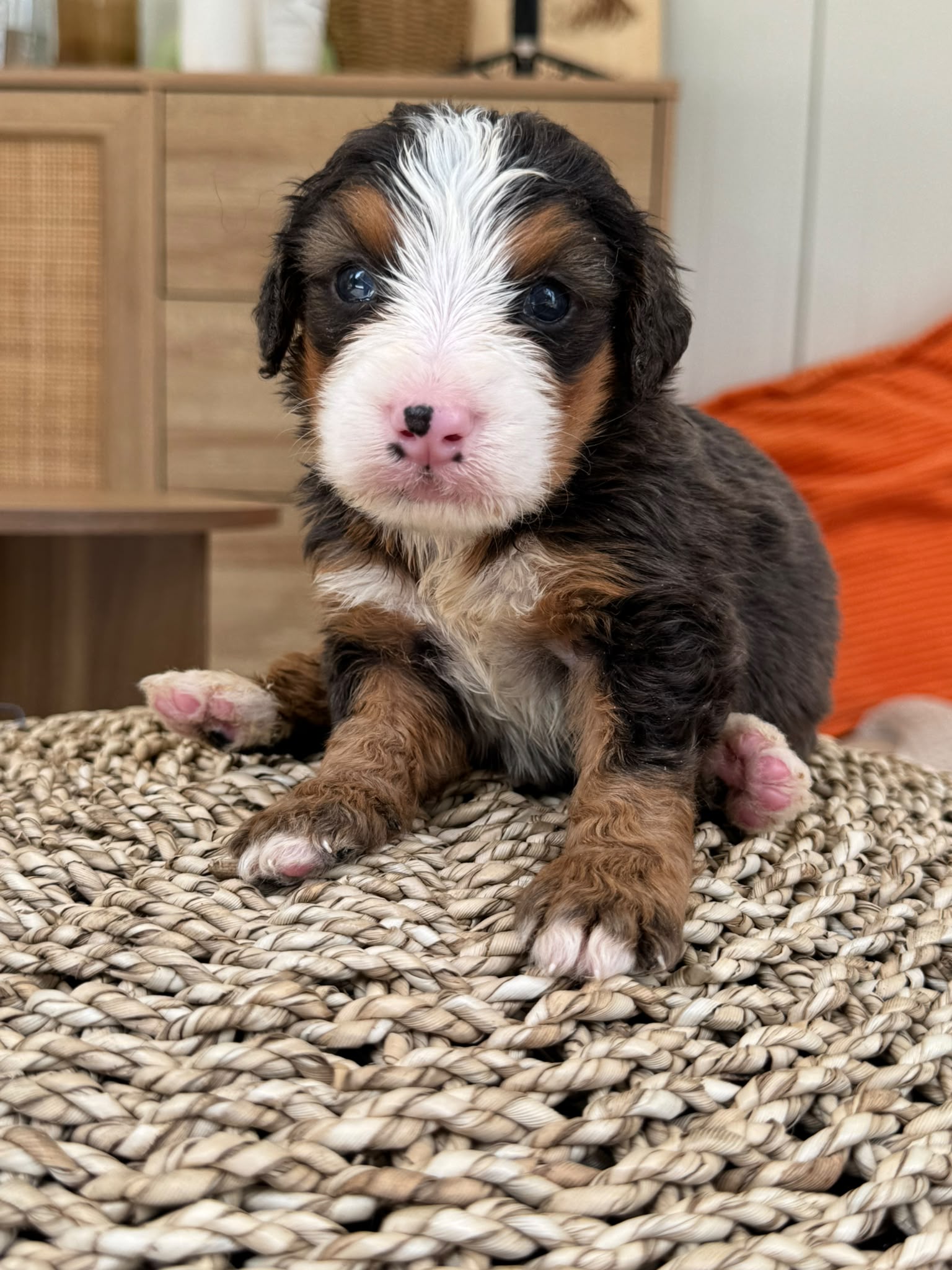
Black tricolor
A blend of three colours with black dominating, then touches of brown and white.
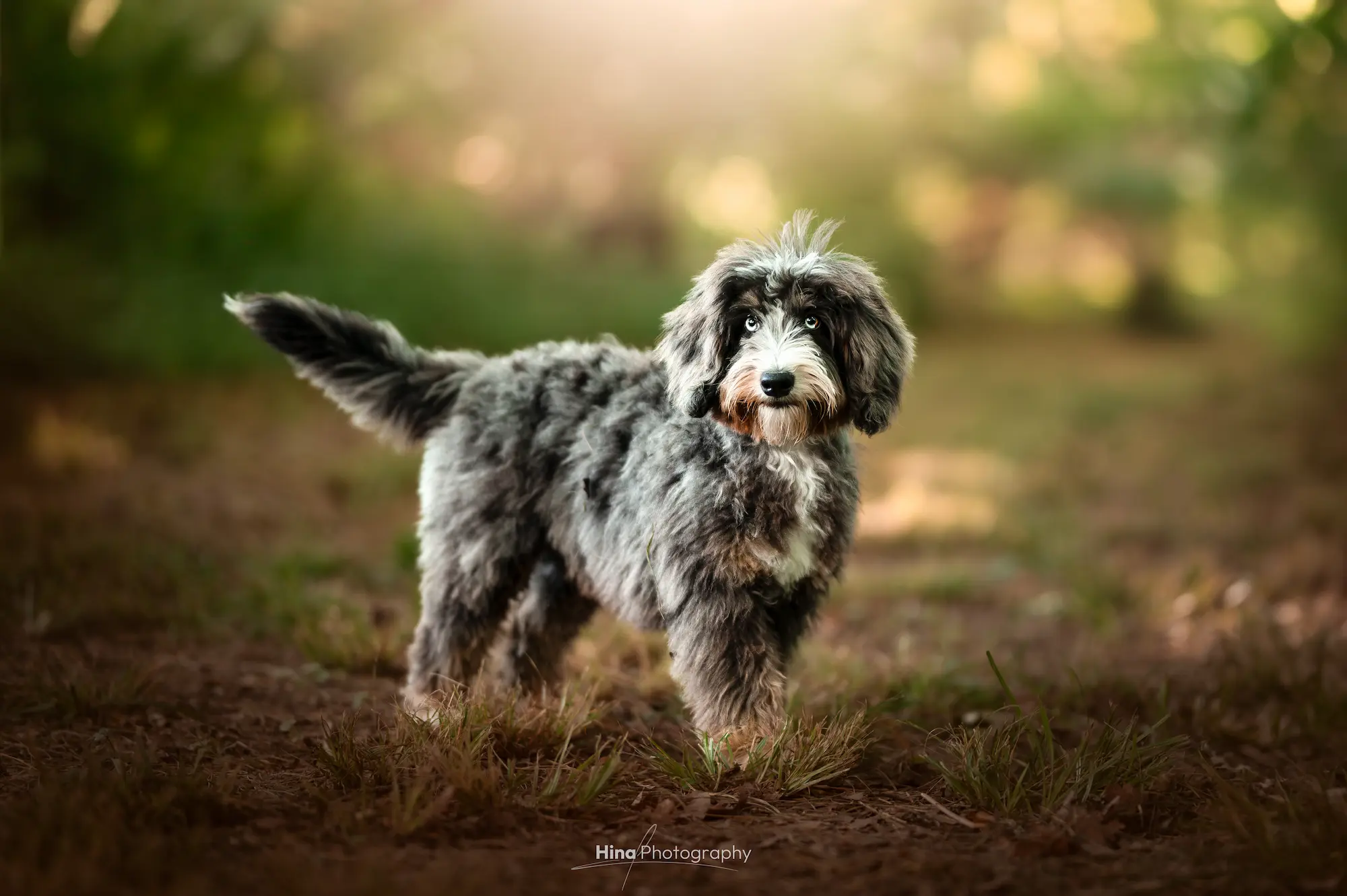
Blue merle
A stunning colour: a marbled mix of grey with brown, black and white.
Red tricolor
A gorgeous coat combining dark brown, light brown and white.
Red merle
A mottled mix of brown and white, with marbled shading.
Red
A beautiful colour close to ginger, with a more or less intense tone.
Minimal white
Every one of these colours can also come as "minimal white" — that is, with very little white.
The history of the Bernedoodle
Bernedoodles are hybrid dogs — the offspring of a cross between two breeds, here a Bernese Mountain Dog and a Poodle. The aim is to combine the strengths of both. The Bernese Mountain Dog is known for its gentleness and its love of children, but it also has one of the shortest life expectancies of any breed (6 to 8 years); the Poodle is famous for its intelligence and how little it sheds.
The first Bernedoodles appeared in North America. The first generation (F1) is generally credited to Sherry Rupke, a Canadian breeder, in the early 2000s: she wanted a dog with the gentle temperament of the Bernese Mountain Dog that also inherited the Poodle's intelligence and hypoallergenic coat.
The Bernedoodle is a "designer dog": a hybrid created to be a good family dog, aiming for a balance of temperament, intelligence and health.
Character and temperament
Personality traits
Bernedoodles inherit the friendly, loyal traits of the Bernese Mountain Dog along with the playful, energetic nature of the Poodle. Their intelligence makes them easy to train and they love being close to their family, which makes them excellent therapy dogs.
Why do they adapt so well?
A very well-balanced temperament: they adapt to different environments and to families of every size. Very active outdoors, just as happy relaxing at home, and highly sociable with other animals.
The myths
Not every Bernedoodle is hypoallergenic: it depends on the generation and on the quality of the coat (its "furnishings"). For a genuinely hypoallergenic dog, you need to look for a double-furnished (FF) dog.
The different Bernedoodle sizes
Mini
30–45 cm · 10–20 kg
Usually the result of crossing a Bernese Mountain Dog with a Toy or Miniature Poodle, or of two later-generation Bernedoodles. They stand around 30 to 45 cm tall and weigh 10 to 20 kg.
Medium
A good middle ground. A good choice for families who want a dog a little larger than the Mini, but not as substantial as the Standard.
Standard
Up to 75 cm · 40 kg
The largest of the three, often a first-generation cross with a Standard Poodle. It can reach 75 cm and weigh up to 40 kg.
Bernedoodle generations
Every generation starts with the letter "F", which stands for "Filial", and the number tells you the generation. They let breeders target specific characteristics: allergenicity, coat texture and overall health.
50% Poodle50% Bernese
75% Poodle25% Bernese
87.5% Poodle12.5% Bernese
50% Poodle50% Bernese
62.5% Poodle37.5% Bernese
81.25% Poodle18.75% Bernese
50% Poodle50% Bernese
The higher the Poodle share, the more the coat tends to be curly and hypoallergenic. The F2 and F3 generations, from two Bernedoodles, stay around 50/50. A "B" marks a backcross: a cross back to a Poodle.
Why choose a Bernedoodle?
- Low shedding: often considered hypoallergenic, and well suited to allergy sufferers.
- A family dog: highly sociable, patient, and a wonderful companion for children.
- Intelligence: easy to train, though they do need mental stimulation.
- Adaptability: equally at home in a flat or in the countryside, as long as they get enough exercise.
- An affectionate temperament: often called a "velcro dog", because they love being close to their family.
- Hybrid health: hybrid vigour often gives them better overall health than either parent breed.
Care and grooming
The Bernedoodle is a dog whose coat demands real discipline.
Grooming
Their wavy or curly coat should ideally be brushed every day to prevent matting. A professional groom is recommended every two to three months. Ears need cleaning regularly (the groomer also plucks the hair inside them) to avoid infections.
Exercise
At least one hour a day: walks, play or training sessions. Bernedoodles also love hiking, ball games and agility courses.
Diet
A balanced diet rich in protein, vitamins and minerals, matched to their size, age and activity level. High-quality kibble or a fresh-meat diet.
Health and vet care
A minimum of 4 check-ups before their first birthday, then at least once a year as an adult. Keep an eye on your dog and see a vet at the slightest doubt or change in behaviour.
Training your Bernedoodle
Bernedoodles are intelligent and respond extremely well to positive, reward-based training.
- Early socialisation: expose your puppy to a variety of people, sounds and situations as soon as their vaccination booster allows. They need to go out every single day: a garden provides no socialisation at all.
- Basic training: their name, "sit", "stay", "come". A long line makes it quick to build a reliable recall outdoors.
- Crate training: excellent for house-training and for giving them a safe place of their own. The crate must always stay a positive space, never a punishment.
- Positive reinforcement: treats, strokes and verbal praise. Never use physical punishment.
Watch out for separation anxiety: teach them to be alone gradually. Boredom can lead to destructive behaviour, so interactive toys and mental stimulation are essential.